May 31, 2026 · BlueGPS Team
Built for the cleanroom floor.
Real-time location intelligence for satellite manufacturing. Just-in-Time component flow, flight hardware traceability and cleanroom efficiency.
The cleanroom problem nobody talks about.
Constellations are forcing satellite manufacturers to think like a factory. The plan looks great on paper. Then the components show up late.
By the BlueGPS Team · Milan
Satellite manufacturing used to be a craft. One spacecraft. Years of integration. A handful of engineers who knew every harness by name. Then OneWeb happened. Then Starlink. Then IRIS². The European Union committed to a sovereign constellation. Galileo went into a second generation. And quietly, in cleanrooms from Cannes to Toulouse to Rome, the industry stopped building satellites the way it used to.
Now there are batches. Lines. Sequences. The same satellite, twelve times, staggered by a week, all sharing the same TVAC chamber. The same harness, integrated into bus number seven while bus number three is still in vibration test. And the same paper traveller, walking from one bonded store to another, the way it has for forty years.
The plan looks great on paper. Then the harness shows up late. The vibe table sits empty for three hours. An operator certified for crimping is sent to a station where she cannot legally sign. And somewhere a programme manager realises that the launch slot — non-negotiable, paid for, scheduled — is six weeks closer than the campaign is.
In constellation-era manufacturing, the line between schedule and reality is where every euro of margin lives.
THE FIVE PROBLEMS
What actually slows you down?
If you run an AIT facility, you are already familiar with these. They do not show up in a Gantt chart. They show up in standup, around coffee, in the form of “have you seen the harness?“
01 The component that isn’t where it should be.
It exists. It has a serial number. It cleared QA last Tuesday. But right now, with the operator gowned up and the integration window open, nobody can tell you which bonded store it sits in. Multiply this by a constellation, and Just-in-Time becomes a slogan, not an operating model.
02 The test bench that costs more to idle than to run.
Thermal vacuum chambers, vibration tables, and EMC anechoic rooms. Capital equipment with an eight-figure replacement value. Booked weeks ahead. Used for less time than booked. Nobody is measuring it. Everyone is paying for it.
03 The traveller that lives on paper.
Every flight component carries a chain of custody from raw material to launch pad. Today most of that custody lives in stapled paperwork, dual-signed forms, and a controlled-document drawer. Then a post-launch anomaly hits, and somebody spends three weeks trying to reconstruct who touched what.
04 The qualification that nobody is checking in real time.
Crimping. Optical alignment. Propellant handling. Each requires a specific certification. Each ESD-protected zone requires specific footwear, wrist straps, and gowning. On paper, this is enforced by training records. In the cleanroom, it is enforced by trust.
05 The serial line that nobody can sequence.
Twelve satellites in the same line, staggered by days, sharing the same stations. When the first one slips a week, the question is not “who is at fault”. The question is: where does the slip propagate, and how do you re-sequence the next eleven without a Sunday rebuild of the schedule?
HOW WE FIX IT
Real-time, not retrospective.
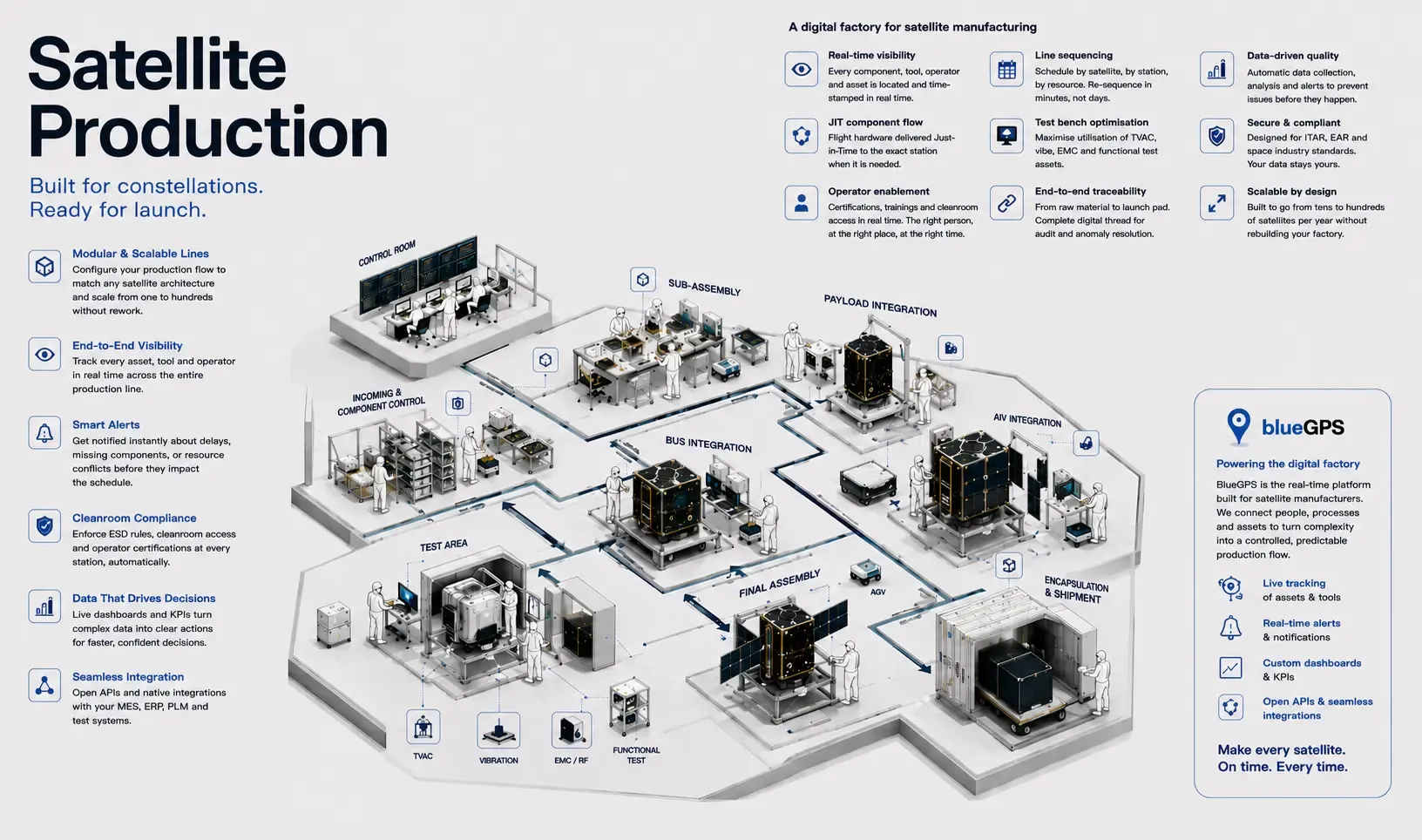
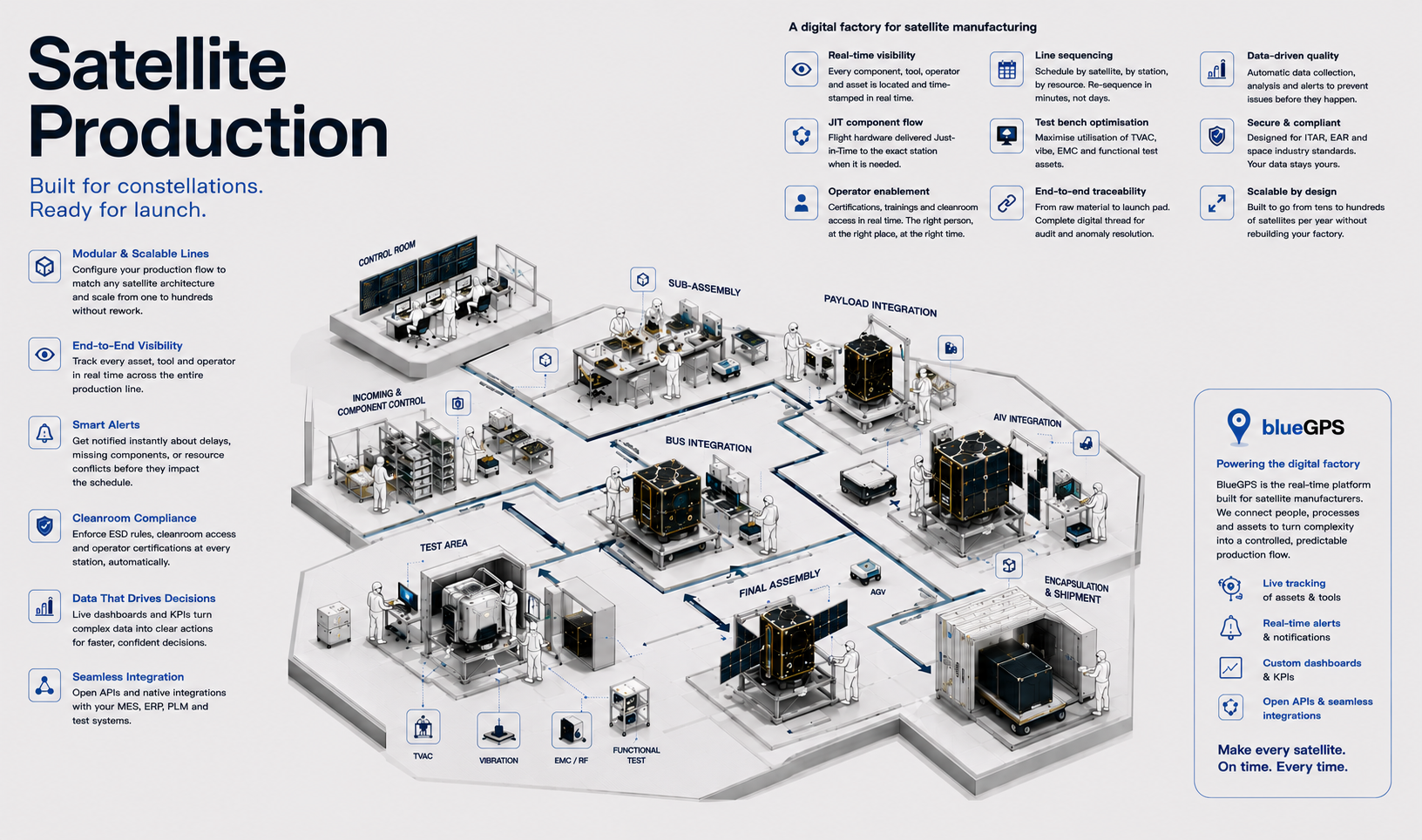
Flight components move through five states: stored, in transit, integrated, tested, shipped. BlueGPS time-stamps every transition automatically.
We built BlueGPS because the planning systems satellite manufacturers already use — MES, ERP, PLM — were not designed to answer the question “where is the harness right now”. They were designed to answer “where should the harness be on Wednesday”.
What we add is the layer underneath: a real-time map of the cleanroom floor. Every flight component, every operator, every GSE unit, every test bench — tagged, located, time-stamped. Just-in-Time delivery to the integration station becomes operational, not aspirational. Just-in-Line sequencing for serial production becomes a live dashboard, not a planning artefact. Test bench utilisation becomes a number you can defend in a CFO review.
And because we have built this for cleanrooms, not for warehouses, the platform speaks the language of AIT: clean zone transitions, ESD compliance, operator certifications, qualified bonded-store releases. Not bolted on. Built in.
THE TAG FAMILY
A label for everything that matters.
Industrial tags. Slim ESD-safe badges. Asset clip-ons. Smart electronic labels. Wearables. And torque tools that certify their own torques.
A satellite cleanroom is not a warehouse. The tag you put on a flight component cannot be the tag you put on a tug. The badge on an operator who handles propellant cannot be the badge on a visitor crossing from one airlock to another. We have spent years building a family of form factors and sensors that map to how AIT actually works.
Industrial tags for tools, GSE, and trolleys IP67, multi-year battery, validated for cleanroom conditions. ESD-safe slim cards for operator badges. Wearable lone-worker tags with man-down detection for confined spaces. And, for those who want to push further, electronic shelf-label-style smart labels, the kind that already exist in supermarkets thanks to companies like SES-imagotag, can be adapted into your bonded store so every flight component has a live, updatable digital identity card sitting next to it.
Then there are smart torque tools. Because in a satellite, a torque is not a torque it is a certified torque, traceable to a specific operator, a specific fastener, a specific moment. We integrate smart torque wrenches that record every tightening event, link it to the component, link it to the operator, and turn what is today a manual stamp on paper into an automatic, audit-grade record.
If a digital price tag in a supermarket can talk to a server, so can a label on a satellite harness.
THE PROOF
We have already done this. In your industry. On your floor.
Two of the most demanding aerospace organisations in Europe. Both production. Both references.
This is the part most RTLS vendors cannot say. We have already deployed BlueGPS at Thales Alenia Space in Rome. We have already deployed it across Airbus Helicopters’ facilities. We have walked these cleanrooms. We have surveyed the radio environment around integration jigs.
WHAT IT COSTS
Less than you would expect. On purpose.
Traditional RTLS is expensive. Closed hardware, proprietary tags, multi-year deployments, vendor lock-in. We rebuilt the model. Hardware-agnostic, so you buy tags at market price. Indoor and outdoor on one platform, so you do not pay for two systems. On-premise with zero cloud dependency, because for sovereign and ITAR-controlled programmes that is non-negotiable. And SaaS or licensed deployment, depending on how your CFO wants to book it.
The result is flight-grade location intelligence that fits inside a single programme’s contingency budget. The business case usually pays back within the first serial batch.
THE NEXT STEP
Ninety days. One cleanroom. Real numbers.
We do not sell ten-year contracts to companies that have not seen the platform run. Every BlueGPS engagement in space manufacturing starts the same way: pick one cleanroom, pick the three KPIs that matter most, run a structured ninety-day pilot. At the end, you have the numbers. You decide what comes next.
If the five problems above describe your AIT floor, and if you have read this far, they probably do there is exactly one question worth asking next.
Who do you want walking your cleanroom with you?