
May 22, 2026 · BlueGPS Team
How Real-Time Location Systems Are Changing MRO Operations
In MRO, the gap between what's planned and what's actually happening on the floor is where costs accumulate. Missing tools, stalled work orders, and delays that go unnoticed until they're already expensive are the daily reality for facilities running without real-time operational data. This article explains how RTLS closes that gap, how the technology works in practice, and where it delivers the most measurable value.
Maintenance, repair, and overhaul (MRO) is fundamentally about control. Over tools, parts, workflows, and time. Yet most facilities still run on a combination of manual updates, spreadsheets, and fragmented systems. The result is that teams know what should be happening, but not what is happening right now.
In MRO, small delays can become costly. A missing tool holds up a technician. A misplaced component stalls a work order. A bottleneck in one bay backs up the entire hangar schedule. These are the daily reality in facilities that lack real-time operational data.
Real-time location systems (RTLS) address this by creating a continuous data layer across assets, personnel, and processes. This article explains what RTLS means in an MRO context, how it works in practice, and where it delivers the most operational value.
What RTLS Actually Does in an MRO Environment
RTLS uses a combination of tags, fixed infrastructure (anchors or readers), and a location engine to generate real-time position data for tracked assets. Tags are attached to tools, components, ground support equipment (GSE), or worn by personnel. The system calculates their position continuously and translates that into usable operational data.
The result is a shift from event-based data to real-time data. Most CMMS, EAM, and ERP systems rely on manual input or discrete scans. They capture events (a tool checked out, a work order opened) but not the continuous reality of what’s happening on the floor. RTLS fills that gap.
In MRO environments, RTLS creates visibility across two distinct but related areas:
Asset visibility. Knowing where tools, components, and equipment are at any given moment.
Process visibility. Understanding workflow status, work-in-progress (WIP) across maintenance bays, and where delays are forming.
Arguably process visibility is more important and valuable than simple asset visibility, but given the technology is the same, the most impactful RTLS deployments should address both simultaneously.
The Specific Problems RTLS Solves in MRO
The operational problems that RTLS addresses in MRO tend to cluster around a few core issues.
Tool and Equipment Location
Tools leave the tool store and don’t come back on time (or at all!). Technicians spend measurable time each shift searching for equipment. In aviation MRO specifically, this also creates foreign object damage (FOD) risk when tools are left in or near aircraft unintentionally.
RTLS provides continuous location data for tagged tools, including whether they’re in authorised zones, whether they’ve returned to the tool crib or store, and whether calibration status is current. In regulated environments, tool traceability is a compliance requirement, and time-stamped location records provide the audit trail that manual logs can’t reliably produce.
Work-in-Progress Visibility
Without real-time data, supervisors rely on check-ins, status updates, and gut feel to understand where a work package stands. That works until it doesn’t (usually when a delay has already cost significant time before anyone notices or flags it).
RTLS makes WIP visible without requiring anyone to report it. By tracking the location of technicians, tools, and materials relative to defined work zones, the system can measure dwell time, identify when an asset has been stationary too long, and surface bottlenecks as they develop rather than after the fact.
In practice, this translates to better coordination across bays and shifts, and more accurate turnaround time management.
Ground Support Equipment Utilisation
GSE — tugs, access platforms, power units, test rigs — is expensive, shared across teams, and frequently unavailable when it’s needed. Poor visibility leads to either unnecessary capital expenditure (buying more equipment to compensate for low availability) or delays when technicians can’t locate what they need.
Continuous location tracking of GSE equipment gives operations teams an accurate picture of where equipment is, how it’s being used across shifts, and whether there are patterns of under- or over-utilisation that should inform planning decisions.
Compliance and Traceability
In aerospace MRO, maintenance activities are subject to strict regulatory requirements. Evidence of who performed each task, with which tools, in which zones, must be recorded accurately. When that evidence relies on retrospective manual entry, it introduces risks that the records may be incomplete, inconsistent, or simply wrong.
RTLS generates time-stamped, location-based records automatically. This includes technician presence in controlled zones, tool usage at specific aircraft, and material movement through defined process steps. The result is a verifiable audit trail that reduces both manual documentation effort and compliance risk.
How the Technology Works: A Practical Overview
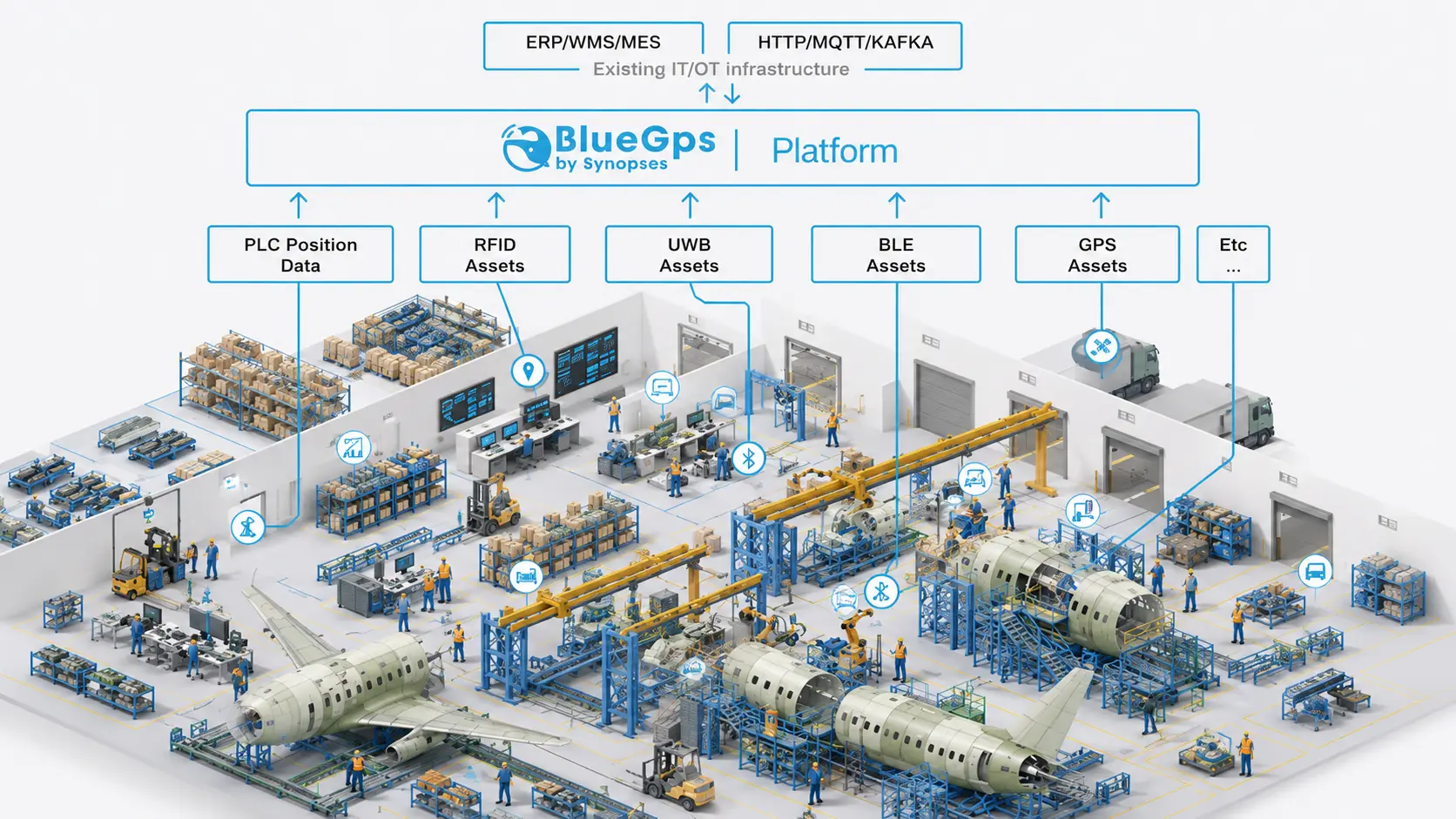
RTLS is not a single technology, it’s a category of approaches, and the right one depends on the operational environment.
UWB (Ultra-Wideband) offers the highest positioning accuracy (centimetre level) and is suited to complex, dense environments where precise location matters, for example, confirming a tool is at a specific fastening on a component rather than just in the general hangar area.
BLE (Bluetooth Low Energy) is lower cost, scalable, and well-suited to both granular and zone-level tracking. It works effectively for identifying which part of an aircraft an asset is located in or next to (sub-metre level accuracy), tracking personnel presence in work zones, and managing large numbers of tagged items simultaneously.
GPS covers outdoor areas such as aprons, tarmac, and combined with BLE can track transitions between indoor and outdoor spaces. In facilities where assets move between hangars and outdoor areas, a system that seamlessly handles both environments avoids the data gap that occurs when assets leave indoor coverage.
RFID remains useful for discrete checkpoint tracking such as confirming an asset passed a specific point rather than providing continuous location data. Very useful for high volumes of low value assets or materials.
Modern RTLS platforms, including those designed specifically for aerospace and MRO, combine these technologies within a single system. This matters because MRO environments are complex: metal-dense structures interfere with signals, indoor and outdoor zones need to be covered, and accuracy requirements vary across different use cases within the same facility.
A good RTLS platform also needs to account for scale. Tracking hundreds of assets is straightforward. Tracking tens of thousands of tools, components, and personnel across multiple bays simultaneously requires architecture built for high-frequency updates with sub-second refresh rates and no degradation in performance as the asset count grows.
Integration: Where RTLS Becomes Operational
Location data on its own is useful. Location data integrated with existing operational systems is where RTLS delivers its full value.
The key integrations in MRO environments are:
- CMMS/EAM. Linking location events to work orders, maintenance records, and asset histories. When a tool enters a calibration zone, the CMMS record can update automatically. When a component arrives at a bay, the associated work order can reflect that.
- ERP. Connecting inventory location data to procurement and financial systems.
- MES. Enabling production and workflow coordination based on real-time asset positions.
These integrations close the loop between physical reality and the systems that manage it. Without them, RTLS is a separate visibility layer that requires manual reconciliation. With them, it becomes part of how work gets done.
Deploying RTLS in MRO: Avoiding Common Pitfalls
RTLS deployments that fail to deliver tend to share common characteristics. Understanding them upfront makes the difference between a system that becomes embedded in operations and one that gets bypassed.
Infrastructure design matters. Poor tag placement or inadequate anchor coverage produces unreliable data. In metal-rich environments like hangars, the RF environment needs to be properly surveyed and tested before full deployment. Accurate data is the foundation as everything else depends on it.
Tag management is operational work. Tags need to be maintained, replaced, and correctly assigned to assets. If this isn’t built into normal operations, the asset register drifts out of sync with reality and system reliability drops.
Without integration, the value is limited. A standalone RTLS system shows you where things are. Integrated RTLS changes how work gets planned, executed, and verified. The integration work is non-trivial, but it’s where most of the business value comes from.
Adoption requires trust. Operational teams need to trust the data before they’ll act on it. That means accurate positioning, intuitive interfaces, and clear use cases tied to problems teams actually experience.

What Good Looks Like: Measured Outcomes
The value of RTLS in MRO is measurable, and deployments that establish baseline metrics before implementation can demonstrate concrete improvements.
Key metrics that change with effective RTLS include:
- Tool search time per technician per shift
- Turnaround time for specific maintenance tasks
- WIP aging across process stages
- Asset utilisation rates for tools and GSE
- Inventory accuracy
- Compliance documentation completeness
In aerospace MRO specifically, productivity improvements of up to 10% have been cited in the context of work package execution (driven by better coordination, reduced idle time, and faster identification of delays). Tool search time reductions of 2–5% per person per shift are achievable through continuous location visibility alone. Multiplied for a typical operation with tens or hundreds of technicians, this can deliver savings that justify the investment alone.
The ROI case for RTLS in MRO is typically built on a combination of labour efficiency gains, reduced capital expenditure on equipment (through better utilisation), compliance risk reduction, and turnaround time improvement. For facilities where aircraft-on-ground time carries direct financial cost, even modest improvements in throughput and coordination have significant financial impact.
The Broader Shift: From Tracking to Process Control
It’s worth being clear about what RTLS is and isn’t. It isn’t a replacement for CMMS, EAM, or ERP. It doesn’t manage maintenance planning or scheduling on its own. What it does is provide the real-time operational layer that those systems have always lacked.
Most maintenance systems are designed around planned work - what should happen, in what sequence, with what resources. RTLS connects that plan to execution reality. It answers the question that planning systems can’t: not what is scheduled to happen, but what is actually happening right now.
Teams stop operating on assumptions and delayed reports. They operate on current state. In an environment where delays, errors, and inefficiencies compound rapidly, that shift has measurable impact on throughput, cost, and service quality.