June 12, 2026 · BlueGPS Team
RTLS for Pharmaceutical Manufacturing: Asset Visibility and Traceability Guide
Learn how RTLS for pharmaceutical manufacturing improves asset tracking, compliance, traceability, material flow, cleanroom visibility, and production efficiency.
RTLS for Pharmaceutical Manufacturing: Asset Visibility and Traceability Guide
Pharmaceutical manufacturing depends on control. Materials must move through the right process steps. Equipment must be available, clean, calibrated, and ready for use. Batches must stay within defined conditions. Quality teams must prove what happened, where it happened, and when it happened.
In many facilities, that control still depends on manual checks, barcode scans, paper logs, spreadsheets, and radio calls. These methods can work, but they often create gaps. Operators may know that a pump, tote, pallet, tool, or mobile asset exists in the plant, but they may not know where it is now. A batch may be waiting for equipment. A cleanroom may be ready, but the required asset may be in another area. A deviation investigation may depend on records that show process steps, but not the exact physical movement behind them.
RTLS changes that. A real-time location system gives pharmaceutical manufacturers live visibility into the location and movement of assets, materials, equipment, and people. It connects physical operations to digital systems so teams can see how work flows through the plant.
For pharma manufacturers, RTLS is not just an asset tracking tool. It can support traceability, audit readiness, process control, utilization, material flow, and production planning. The value comes from knowing where things are, how long they have been there, and how their movement compares with the process that was planned.
What Is RTLS in Pharmaceutical Manufacturing?
RTLS stands for real-time location system. It uses tags, sensors, gateways, anchors, and software to identify and locate objects or people inside a facility. In pharmaceutical manufacturing, those objects may include portable equipment, raw materials, intermediate goods, finished goods, tools, cleanroom assets, carts, containers, and work-in-process batches.
Unlike basic inventory records, RTLS does not only tell a user that an asset exists. It shows where that asset is in real time or near real time. Depending on the technology used, the system may locate an item at room level, zone level, shelf level, or with much higher precision.
A typical RTLS setup includes three core parts.
- First, tags are attached to assets, materials, containers, or badges. These tags send or reflect signals.
- Second, fixed infrastructure such as gateways, readers, anchors, or sensors detects those signals across defined areas.
- Third, software converts the location data into maps, dashboards, alerts, event logs, reports, and integrations with other systems.
In a pharma plant, RTLS becomes more valuable when it links to systems such as MES, ERP, WMS, LIMS, QMS, CMMS, digital batch records, or building management systems. Location data on its own helps people find things. Location data connected to process context helps teams manage production, quality, and compliance.
Why Pharma Manufacturers Need Real-Time Location Visibility
Pharmaceutical manufacturing has many moving parts. A single batch can involve raw materials, weighing, staging, processing, sampling, cleaning, quality checks, storage, packaging, and release. Each stage may depend on specific equipment, trained personnel, cleanroom access, and approved documentation.
Delays often occur between process steps rather than during the steps themselves. A material may wait in staging. A mobile asset may be used in one suite but needed in another. A batch may pause because a container, pump, tool, or calibrated instrument cannot be found. A quality team may need to reconstruct the movement of an item after an exception.
These problems create direct operational cost. Teams lose time searching. Equipment utilization falls. Changeovers take longer. Production schedules become harder to hold. Manual records increase the burden on operators and quality staff.
They also create compliance risk. In regulated manufacturing, incomplete visibility can make it harder to prove chain of custody, investigate deviations, confirm environmental exposure, or support electronic batch records. RTLS helps close these gaps by creating a digital record of physical movement.
The main point is simple: if a process depends on assets and materials moving through controlled spaces, location data becomes part of process control.
Key RTLS Use Cases in Pharma Manufacturing
RTLS can support several use cases in pharmaceutical manufacturing. The best starting point depends on the site’s pain points, process risk, and business case.
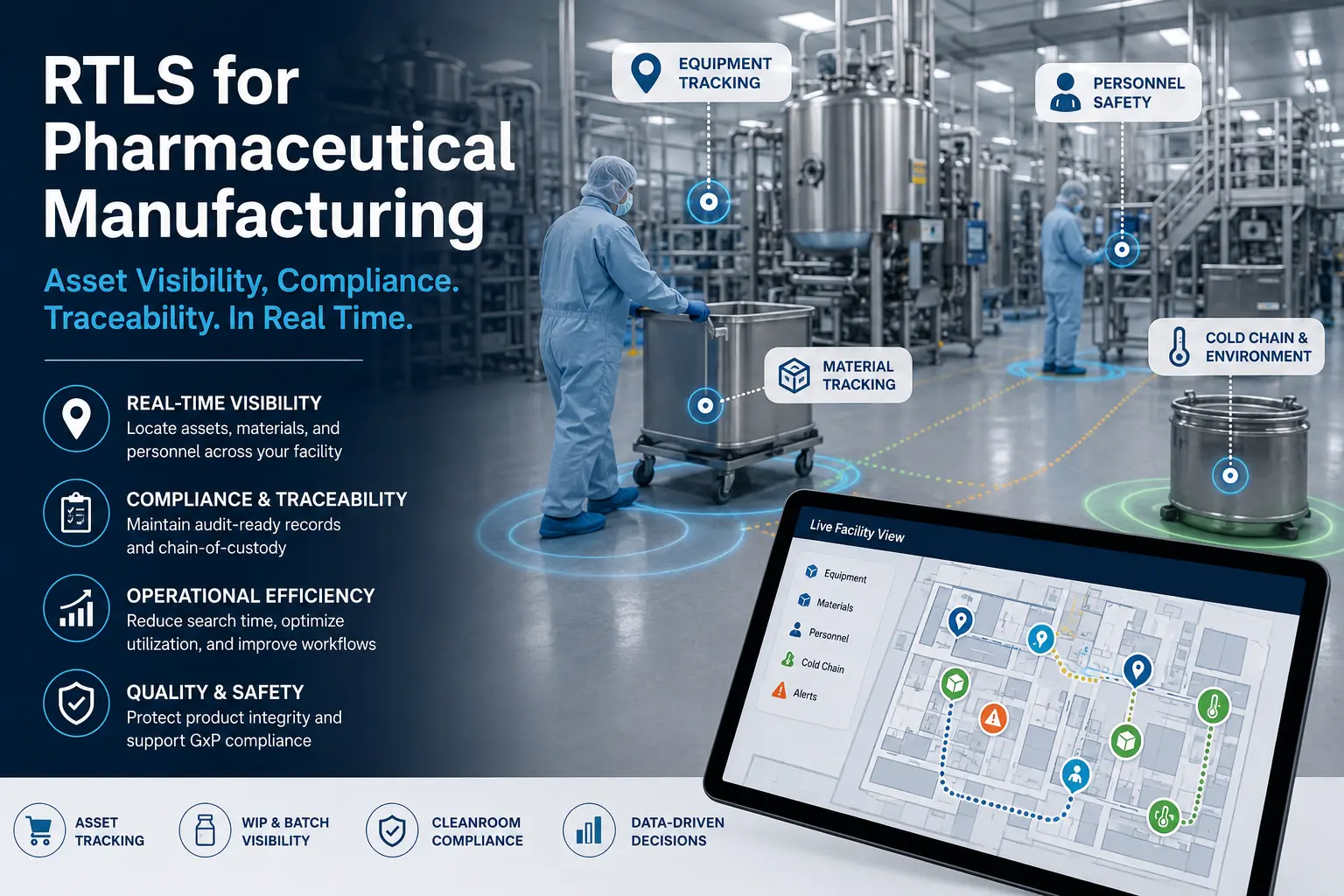
Asset tracking
Portable equipment is often shared between rooms, suites, production lines, labs, and storage areas. This may include pumps, scales, vessels, totes, carts, cleaning equipment, tools, test devices, and calibrated instruments.
When these assets are difficult to find, operators lose time and production steps wait. RTLS allows teams to search for assets on a live map, filter by asset type, status, location, or availability, and confirm whether equipment is in the right area before a process begins.
Material tracking
Materials often move through receiving, quarantine, sampling, weighing, staging, dispensing, production, packaging, and storage. RTLS can show where materials are and how long they have stayed in a given zone.
This is useful when materials have handling rules, hold-time limits, shelf-life restrictions, temperature requirements, or chain-of-custody needs. It also helps reduce duplicate movement, unnecessary re-staging, and manual checks.
Work-in-process and batch visibility
WIP tracking gives production teams a live view of where a batch, container, or intermediate product sits in the manufacturing flow. This helps supervisors identify bottlenecks, waiting time, and process gaps.
For example, a batch may leave one step but wait before the next step because equipment, personnel, or quality approval is not ready. RTLS can help show the difference between active processing time and waiting time.
Cleanroom asset visibility
Cleanroom environments often require strict control over what enters, where it goes, how long it stays, and whether it is suitable for use. RTLS can support visibility of mobile cleanroom assets and controlled equipment inside these spaces.
The system design must account for cleaning procedures, tag materials, mounting methods, signal behavior, and validation needs. In many cases, the value is not only in finding the asset, but in proving that the asset stayed within approved zones.
Cold chain and shelf-life-sensitive handling
Some pharmaceutical materials and products have temperature, time, or shelf-life limits. RTLS can be combined with sensor data to monitor movement and dwell time through cold rooms, staging areas, production spaces, and handoff points.
This does not replace validated environmental monitoring, but it can add context. Teams can see where an item was held, how long it stayed there, and whether it moved through the expected route.
Personnel flow and safety
In some facilities, RTLS can also track personnel movement for safety, access control, evacuation, lone worker protection, or workflow analysis. In regulated spaces, this must be handled with clear governance, privacy controls, and role-based access.
The operational value may include knowing whether trained personnel are present in the right area, confirming occupancy during an emergency, or understanding how movement patterns affect production flow.
How RTLS Supports Compliance, Traceability, and Audit Readiness
Pharma manufacturing runs under regulated conditions. Systems that affect product quality, process control, or records must be managed with care. RTLS does not create compliance on its own. It supports compliance when it is designed, validated, governed, and integrated properly.
The first contribution is traceability. RTLS can create a location history for an asset, material, container, batch, or person. That history can show where an item moved, when it arrived, how long it stayed, and when it left. This can support chain-of-custody records and help quality teams understand whether movement matched the approved process.
The second contribution is audit readiness. Instead of relying only on manual logs or user memory, teams can use time-stamped location data to support investigations, process reviews, and batch history. This can help answer practical questions: Was the material staged in the correct area? Was the equipment in the approved room? Did the item wait longer than expected? Did it pass through a restricted zone?
The third contribution is data integrity. In pharma, records must be trustworthy, complete, and controlled. If RTLS data becomes part of a GMP process or electronic record, the system must be managed accordingly. This may include access control, audit trails, time synchronization, data retention, validation, change control, backup, and review procedures.
RTLS should therefore be treated as part of the wider digital manufacturing architecture. It may sit alongside MES, QMS, LIMS, WMS, ERP, and digital batch records. The goal is not only to collect location data. The goal is to create usable, controlled, and traceable information that supports manufacturing and quality decisions.
RTLS Technologies Used in Pharma Facilities
Different RTLS technologies suit different use cases. A pharma manufacturer should not choose a technology only because it is new or precise. The right choice depends on accuracy needs, facility layout, infrastructure, cost, validation burden, cleaning requirements, and integration needs.
| Technology | Typical strength | Pharma manufacturing fit |
|---|---|---|
| UWB | High location accuracy and low latency | Useful for precise asset tracking, zone control, and high-value process areas |
| BLE | Broad device support and lower infrastructure cost | Useful for room-level or zone-level tracking, especially where high precision is not required |
| RFID | Identification at defined read points | Useful for checkpoints, portals, inventory events, and controlled movements |
| Wi-Fi RTLS | Uses existing wireless infrastructure in some cases | Useful where approximate location is acceptable and infrastructure already exists |
| Hybrid RTLS | Combines technologies for different areas or use cases | Useful for large pharma sites with varied tracking needs |
UWB, or ultra-wideband, can support high-accuracy tracking where the use case needs precise location. BLE, or Bluetooth Low Energy, may suit wider asset tracking where lower accuracy is acceptable. RFID can work well at gateways, doors, storage points, and process handoffs. Wi-Fi tracking can provide broader location signals but may not suit every regulated workflow.
Many pharma sites benefit from a hybrid approach. A plant may use UWB in production areas, BLE for general mobile assets, RFID for checkpoint events, and GPS for external yards or logistics areas. The software layer matters because it must unify these signals into one operating view.
Operational Benefits: Efficiency, Throughput, and Asset Utilization
RTLS creates value when it removes waste from physical processes. In pharma, much of that waste sits in waiting, searching, staging, moving, checking, and investigating.
A production team may spend time searching for a mobile vessel. A warehouse team may stage material twice because its location is not trusted. A batch may wait for a tool that is already in the building but not visible. A quality team may spend hours reconstructing movement after an exception.
RTLS can reduce this friction by giving teams a live view of the plant. Operators can search for assets. Supervisors can see bottlenecks. Planners can understand whether equipment is used or idle. Quality teams can review movement history. Maintenance teams can locate assets due for service or calibration.
Useful KPIs include:
- Search time per asset
- Changeover time
- Equipment utilization
- Batch waiting time
- Material staging time
- Inventory accuracy
- Deviation investigation time
- Unplanned downtime linked to missing assets
- Number of manual location checks
- Time spent reconciling records
The business case often starts with one high-friction process. For example, a site may begin by tracking portable equipment used across several suites. Once the system proves value, the same platform can extend to materials, WIP, cleanroom assets, or cold chain handoffs.
Integrating RTLS with MES, ERP, QMS, LIMS, and Digital Batch Records
RTLS becomes more powerful when location data flows into the systems that already run the plant.
An MES can use location events to support production steps, material readiness, equipment availability, or batch movement. An ERP system can use location status to improve inventory and planning. A WMS can use real-time visibility for staging, picking, and movement. A QMS can use location history during investigations. A LIMS can gain context around sample movement. A CMMS can locate equipment due for maintenance, cleaning, or calibration.
Digital batch records can also benefit from location events when those events support process evidence. For example, a record may show that a tagged material moved from quarantine to dispensing, then to a defined production area. The RTLS data should not replace required quality checks, but it can strengthen the record of physical movement.
Integration also reduces the risk of creating another isolated system. Operators should not need to check one screen for production status, another for quality, another for maintenance, and another for location. A practical RTLS deployment connects location data to the workflows people already use.
How to Evaluate an RTLS Solution for Pharmaceutical Manufacturing
Selecting RTLS for pharma requires more than comparing location accuracy. Accuracy matters, but it is only one part of the decision.
A pharma manufacturer should assess:
- Required location accuracy by use case
- Performance in cleanrooms, production areas, warehouses, and labs
- Tag durability, cleaning compatibility, and mounting options
- Support for UWB, BLE, RFID, Wi-Fi, GPS, or hybrid tracking
- Integration with MES, ERP, WMS, LIMS, QMS, CMMS, and digital batch records
- Audit trails, access control, reporting, and data retention
- Validation and qualification support
- Cybersecurity and role-based access
- Scalability from pilot to multi-site deployment
- Ease of use for operators, supervisors, quality teams, and engineers
- Vendor experience in regulated or industrial environments
A good evaluation starts with the process problem, not the technology. The question is not “Which RTLS technology is best?” The better question is “Which location data do we need to improve this process, and how accurate, timely, and controlled must that data be?”
Implementation Roadmap: From Pilot to Plant-Wide Rollout
RTLS deployment should follow a controlled path, especially in regulated environments.
Start by defining the use case. Choose a process with clear pain, measurable waste, and business value. Examples include locating portable equipment, tracking WIP, reducing changeover delays, or improving material visibility.
Map the workflow. Document how assets, materials, or people move today. Identify handoffs, waiting points, manual checks, and record gaps.
Define the required level of accuracy. Some processes need room-level visibility. Others need more precise location. Avoid over-engineering if the process does not require it.
Select assets and areas for the pilot. Limit the first phase to a defined process, zone, or asset class. This keeps scope under control and makes measurement easier.
Install infrastructure and tag assets. The design must account for building layout, signal behavior, cleaning requirements, restricted areas, and installation disruption.
Validate and govern the system. If RTLS data supports GMP activity, the system may require validation, qualification, audit trails, security controls, change control, and documented operating procedures.
Integrate with core systems. Connect RTLS to the systems that need location events, such as MES, WMS, QMS, CMMS, or digital batch records.
Train users. Operators and supervisors need simple workflows. Quality and IT teams need confidence in data handling, access, and control.
Measure results. Compare pre-pilot and post-pilot KPIs such as search time, waiting time, asset utilization, deviation investigation time, or changeover duration.
Scale with care. Once value is proven, expand by use case, area, asset class, or site. The platform should support phased rollout rather than a single large deployment.
Building the Business Case for RTLS in Pharma
The business case for RTLS should link location visibility to measurable outcomes.
A simple model can start with search time. For example, estimate how many times per week operators search for portable equipment, how long each search takes, and how many people are involved. Then calculate the cost of that time and the effect on production flow.
A second model can focus on asset utilization. If a site buys more mobile equipment because existing assets cannot be found or trusted, RTLS may reduce unnecessary purchases.
A third model can focus on batch flow. If WIP waits between process steps because materials or equipment are not ready, RTLS can help identify and reduce that waiting time.
A fourth model can focus on quality investigations. If teams spend time reconstructing movement during deviations, location history can reduce investigation effort and improve confidence in the record.
The best business case combines operational and compliance value. RTLS may save labor time, but it may also reduce batch delays, support audit readiness, improve process understanding, and increase confidence in controlled movement.
Where BlueGPS Fits
BlueGPS helps manufacturers turn location data into usable operational intelligence. In pharmaceutical manufacturing, that means connecting RTLS technologies to the systems, workflows, maps, rules, reports, and dashboards that teams use every day.
The strength of BlueGPS is its ability to work across different real-time location technologies and use cases. A pharma facility may need UWB in one area, BLE in another, RFID at control points, GPS outside the building, and system integrations across MES, ERP, QMS, WMS, LIMS, or other platforms. BlueGPS provides the software layer that brings that data together.
For pharmaceutical manufacturers, the outcome is clearer asset visibility, stronger traceability, better process control, and a more practical route from RTLS pilot to wider rollout. The value is not just knowing where an asset is. The value is using that location data to run the plant with more control, less search time, and stronger evidence of what happened across regulated operations.